
Marketing Fundamentals
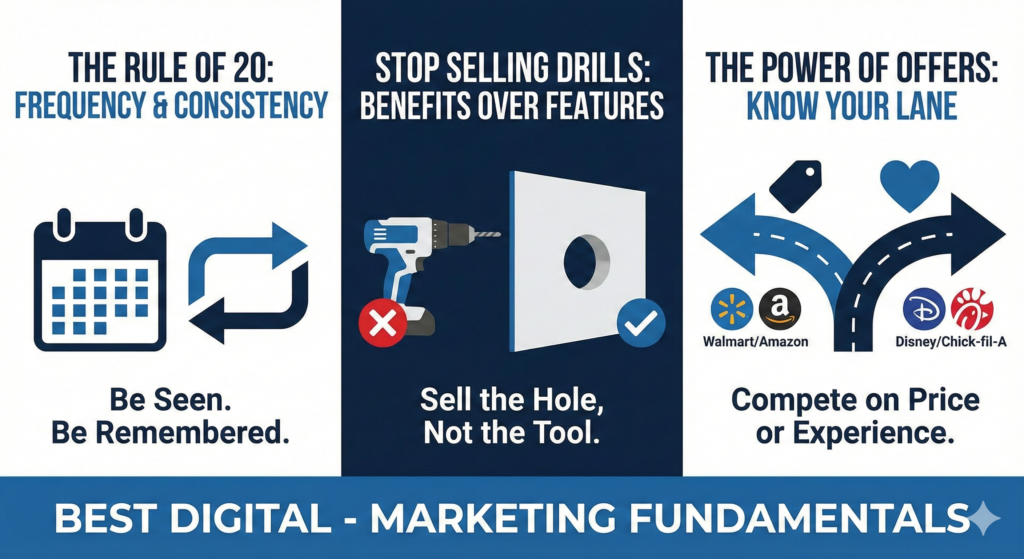
Marketing can feel complicated, but it really comes down to a few simple rules. If you get these right, you will win. If you ignore them, you are likely wasting money.
Here are the fundamentals you need to know:
1. The Rule of 20 (Frequency & Consistency) Have you ever posted on social media or sent an email and wondered, “Why didn’t the phone ring?”
The answer is simple: They didn’t see it. Or if they did, they didn’t care yet.
In 1885, a London businessman offered advice on advertising that is still true today. He explained that the first time people see an ad, they don’t even notice it. By the fifth time, they actually read it. But it isn’t until the twentieth time that they buy what you are selling.
Why do you need to be consistent? It isn’t just about building a brand name. It is because your prospects’ and customers’ needs change every single day.
- Today: Your customer might not need a new roof, so they ignore your roofing ad.
- Tomorrow: A storm hits, and their roof leaks. Now they need you.
If you stop advertising because you think “everyone saw it already,” you will miss them on the exact day they are ready to buy. Success is determined by how many times your target audience sees your message.
The Lesson: When you are finally bored with your own marketing, that is exactly when it’s most likely working for your ideal customers.
2. Stop Selling “Drills” (Benefits vs. Features) The biggest mistake business owners make is talking about themselves instead of the customer. They list “Features” when they should be selling “Benefits”.
- Features are what your product is (size, color, speed, hours).
- Benefits are what your product does to solve a customer’s problem or meet a need.
Theodore Levitt coined the famous phrase “selling the hole, not the drill” in his 1960 Harvard Business Review article, “Marketing Myopia.” He explained that a hardware store sells power drills, but the customer doesn’t actually want a drill. They want a hole. The drill is just the tool; the hole is the benefit.
Your customers are always asking three selfish questions:
- “What’s in it for me?”
- “How does it solve my problem?”
- “How does it make my life better?”
Here is how to flip your script:
- Don’t say: “We have a 15-year warranty” (Feature).
- Say: “Don’t pay for repairs for a decade” (Benefit).
- Don’t say: “This car has a turbo engine” (Feature).
- Say: “You can safely merge onto the highway without worrying about getting hit” (Benefit).
3. The Power of Offers (and Knowing Your Lane) Finally, let’s talk about price.
If price is the main thing your customers care about (think Walmart or Amazon), you must show it. When the price is not shown, people assume it is expensive.
However, if you compete on experience (think Disney or Chick-fil-A), price is secondary. You aren’t selling a cheap ticket or sandwich; you are selling magic and service. In these cases, leading with price can actually hurt your brand.
You can attempt to be both, but it is difficult. The real question you must answer is: Whatever you choose, does your marketing consistently reinforce that strategy?
Your Homework for the Week: Take five minutes today to look at your website pages, billboards, email marketing, social media posts, and ads.
- Read the first sentence. Does it tell them what you do (Feature) or how you help them (Benefit)?
- Ask yourself: “If I were a stranger, would I know what’s in it for me?”
Not sure if you are hitting the mark? Schedule a meeting with our team to discuss a solution.